023 8044 7820
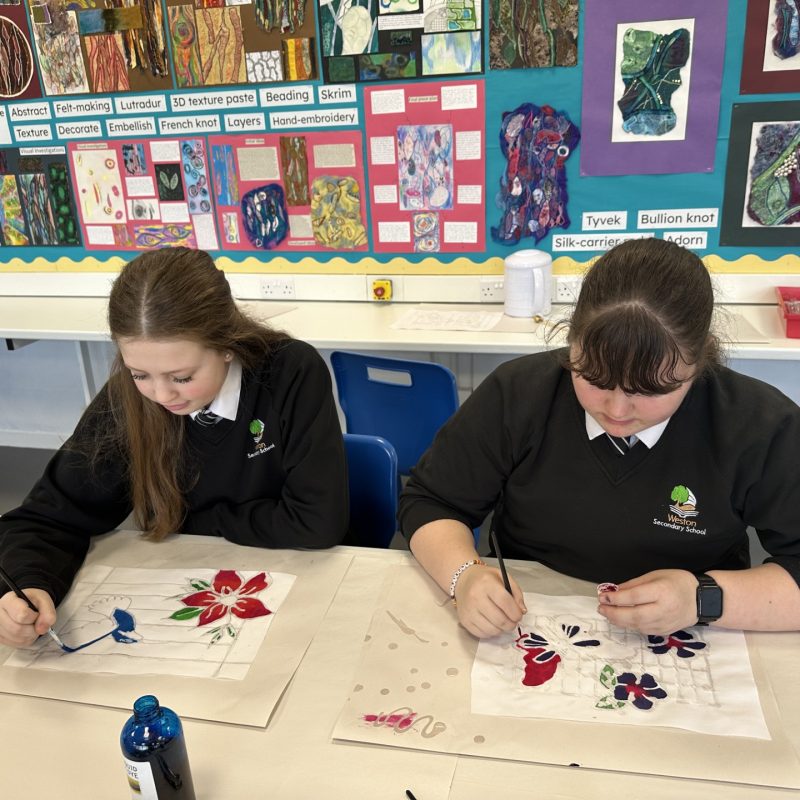
At Weston Secondary School, our vision is to develop creative, confident and technically skilled young designers who can communicate ideas visually through textiles and mixed media. Textiles encourage students to explore materials, techniques, processes and cultural influences while building resilience, independence and pride in their practical work. Through hands-on making, thoughtful experimentation and reflective practice, learners gain a deep appreciation for how textiles contribute to art, design, technology, identity and the wider creative industries.
The Textiles curriculum is designed to provide a rich and progressive learning experience from KS3 into KS4. Our Textiles curriculum sits within the Design and Technology carousel at Key Stage 3 and is designed to reflect the expectations of the UK National Curriculum. At KS3, students build secure foundations in safe working practices, fabric handling, decorative techniques, design development and evaluation. They learn how to research designers, generate ideas, use tools accurately and apply a range of surface and construction methods.
At KS4, the textiles curriculum deepens students’ understanding of textiles within the AQA Art & Design: Textiles framework. Students refine their ability to record observations, develop ideas, experiment with textile processes and present outcomes with increasing independence. They explore a variety of materials, techniques, processes working with textures and mixed media approaches while developing strong visual communication and annotation skills in preparation for GCSE portfolio requirements.
The curriculum is structured to support progression across all four AQA assessment objectives:
- Students develop ideas through purposeful investigations and critical study of artists, designers and contextual sources, aligning with AO1.
- They refine their work by experimenting with media, materials, techniques and processes to explore possibilities and improve outcomes, directly supporting AO2.
- As projects evolve, students strengthen their ability to record observations, insights and reflections using drawing and annotation, demonstrating the requirements of AO3.
- Ultimately, they learn to present a personal, meaningful, and coherent final response that realises their intentions and shows understanding of visual language, fulfilling AO4.
Through this structured approach, students build a coherent body of portfolio work that demonstrates creativity, technical control and thoughtful engagement with themes and influences. This directly reflects AQA’s expectations for:
- Component 1 (Portfolio of work – 60% of final GCSE grade), where students produce sustained projects responding to starting points, project briefs or tasks, and show clear development from initial ideas through to final outcomes.
- Component 2 (Externally Set Assignment – 40% of final GCSE grade)) by developing independence, resilience and the ability to work confidently within time constraints. Collectively, this prepares students for success at GCSE and supports progression into post‑16 creative pathways, in line with the aims of the AQA specification, which encourages creative thinking, risk‑taking, and reflective practice.
The curriculum promotes creativity, critical thinking and craftsmanship. It provides space for personal response, cultural understanding and a strong sense of ownership over creative outcomes.
Textiles at Weston develops the whole student. Our approach supports:
- Knowledge of textiles materials, construction methods, formal elements, contextual influences, sustainability considerations and the creative design process. Students learn how to research effectively and communicate ideas visually and verbally.
- Positive attitudes towards creativity, resilience, independence and respect for diverse textile traditions. Students develop confidence through experimentation, teamwork, reflection and an appreciation of cultural and ethical values in design.
- Practical competence in fabric handling, stitch, embellishment, mixed media techniques, presentation skills and the safe use of textiles tools. Students develop accuracy, control and craftsmanship through structured practice and increasing challenge.
This curriculum reflects national curriculum aims of design, make, evaluate and technical knowledge by enabling students to explore ideas, refine techniques, evaluate outcomes and express themselves through meaningful and personal creative work.